 Memoryby Directive
 In betaMCP-native · self-hosted
The knowledge base your AI tools
can actually read.
Point it at a directory of markdown files and query your knowledge from an AI client, the REST API, the CLI or the built-in web UI.
01The problem
Your AI tools are only as good
as what they can look up.
The knowledge an agent needs is usually scattered: notes in one folder, decisions in another, context in someone’s head. An AI client with no shared knowledge layer answers from whatever happens to be in front of it, and it cannot cite where an answer came from or show what it knew when it acted.
Memory is that layer. Point it at a directory of markdown files and it becomes a knowledge base your AI tools can read and write: from an AI client over MCP, from the REST API, from the CLI, or through the built-in web UI. It is a single Rust binary with SQLite underneath, self-hosted on your own machine, and nothing leaves it.
02See it
Your notes, as a graph.
This is the graph view in Memory’s built-in web UI: every document a node, every wikilink an edge. The same structure is what agents traverse when they follow links from one note to the next.
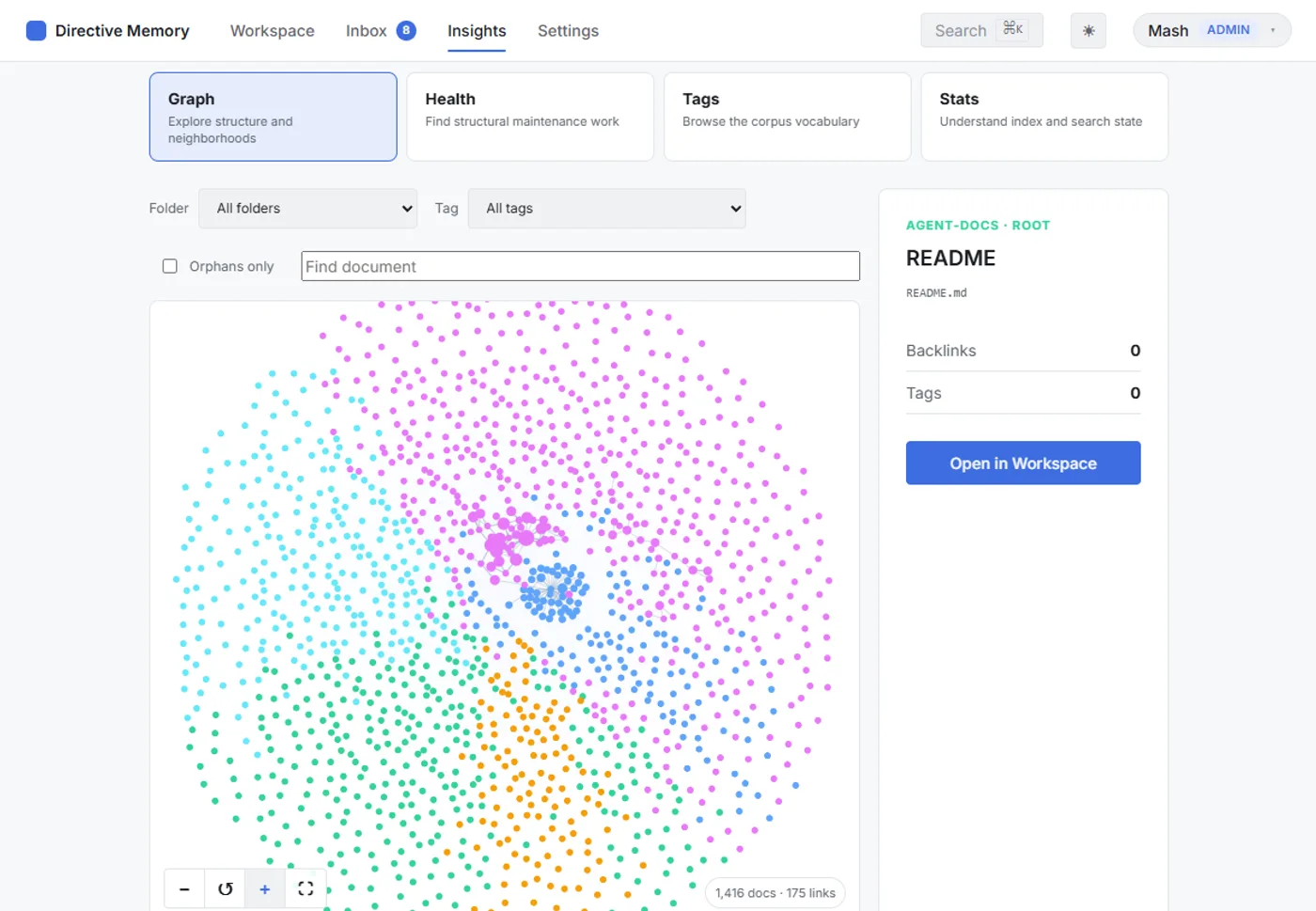
The web UI ships inside the binary. There is nothing extra to install and no separate server to run: start Memory and the graph, search and editing views are there in the browser.
03What it does
Search that ranks well,
structure agents can follow.
Retrieval is hybrid: BM25 keyword search, vector similarity and cross-encoder reranking, with temporal decay so newer knowledge outranks stale knowledge. On top of the files sits a real graph, and around the whole store sits access control built for agents rather than bolted on.
- Markdown-nativeYour files stay as markdown on disk. No lock-in, no proprietary store.
- Hybrid searchBM25, vector and cross-encoder reranking, with temporal decay.
- Knowledge graphWikilinks, backlinks, tags and traversal, plus structural lints.
- Scoped accessPer-agent bearer tokens, per-source ACL and a full audit log.
Because the store is plain markdown on disk, structural lints can tell you what is drifting: broken wikilinks, orphaned notes, tags nothing points to. The knowledge base stays honest the same way a codebase does.
04In beta
Beta, stated plainly.
Memory is in beta. It runs our own knowledge base every day, and we are opening it up carefully rather than broadly: access is by invitation while the edges get worn smooth.
If you want in, ask through the contact page or book a call and we will set you up. No pricing page, no waitlist theatre, just a conversation about whether it fits how you work.
It is built for people who run their own AI tooling: self-hosters, developers wiring agents into their own machines, and businesses that want their knowledge searchable by AI without it leaving their own hardware.
The commitments are the ones the design enforces. Your files stay as markdown on disk, so you can walk away with them at any time. Every agent works through a scoped token, every read and write is in the audit log, and the whole thing runs where you put it.
More from DirectiveFour products, one pattern
Built for one job each,
and yours to keep.
-
 AI Kits Your AI assistant, guided through one job. First up: your business website. directivekits.com (opens in a new tab)
 -
 Composer B2B sales ordering for distributors. Works offline. Read more
 -
 Did It Land Post-talk pages for speakers, shared with one QR code. didit.land (opens in a new tab)
 - All four, side by side Who each one is for, and where each one stands. See the products
Give your tools something to know.
Memory is in beta and access is by invitation. Email us for access, or book a call and we will talk about your files, your agents and the machine it should run on.
Single Rust binary · SQLite underneath · nothing leaves your machine